Apex Heat App updates
Changes made to Apex Heat App, by date: new features, improvements, calculation changes and fixes. Calculation changes are marked separately because they can change the results of properties you have already calculated.
- Improved
An existing energy certificate can now be imported from a scanned PDF or photos of its pages
Reading an existing energy certificate has improved significantly: you can now also upload a scanned PDF or photos of the certificate, and Claude Opus 5.5 reads it into the same fields as a digital PDF. The values are shown for review in the same way before they are applied. A read usually takes 30–60 seconds per certificate and carries on if you leave the page. Values the model is unsure of are marked for checking.
- New
Savings from ventilation controls and equipment renewal are now calculated machine by machine
Two new Beta cards in Investments and measures calculate ventilation schedule optimization, airflow rebalancing, demand-controlled ventilation retrofit and repair, weekend airflow reduction, supply-air temperature reset, EC fan retrofit and ventilation unit replacement. The results show each machine's saving as heat, electricity, carbon dioxide and euros, and the measures are calculated one after another so that no saving is counted twice. The controls measures have no default price, so the contractor's price is entered right under the measure.
Read more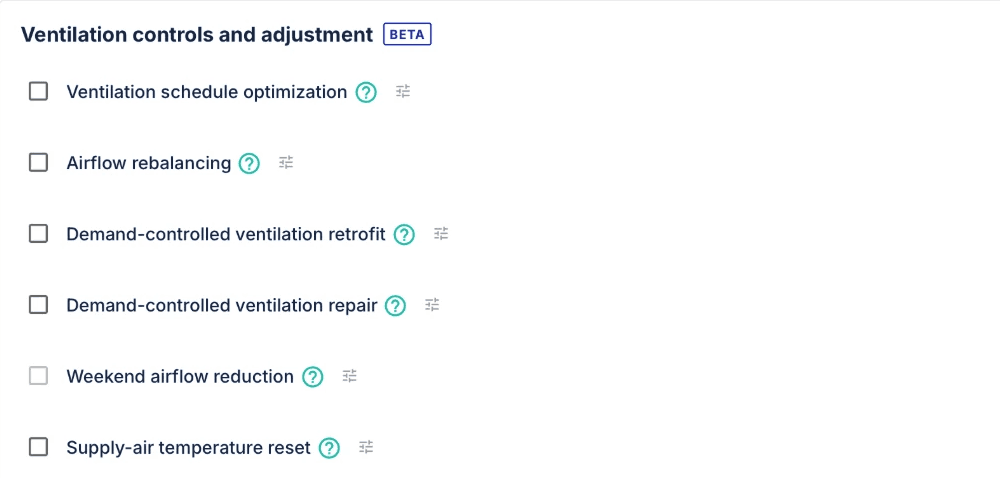
- New
A ventilation unit's model can now be picked from a catalogue of residential units sold in Finland
The model gives the unit's heat recovery temperature ratio and SPI with their source, and a unit can be given an identifier, the spaces it serves and audit details, which the report's ventilation unit table shows. The current and the new schedule can be entered as runs with airflow levels, as an hour grid or as text, and standstill weeks are picked week by week. The schedule change offers example schedules, and choosing CO₂ control calculates a demand-controlled ventilation retrofit for the building.
Other updates
- Improved: The E-number's demand-controlled ventilation reduction can now come from the ventilation plan
- Improved: Small updates to the energy subsidy following the latest version (v3) of Varke's application guide
- Improved: Heating and solar can now be sized on the consumption after LED relighting
- Improved: A field now shows when its choice overrides values you typed in other fields
- Improved: Every map now shows a scale bar in its lower right corner
- Improved: The AI assistant answers regulation questions, draws the drilling map and searches the EPC register
- Improved: Boreholes, start points, collectors and the plant room can be moved on the drilling map
- Improved: The drilling price per metre can be entered by well depth
- Improved: A heat pump's results show its power coverage and bivalence point at the design temperature
- Calculation change: The energy certificate's E-number was refined for thermal bridges and heat recovery
- Calculation change: The certificate reads structures with no renovation year or U-value at the permit year's U-values
- Fixed: A yearly consumption table can now be imported with the years across a row instead of down a column
- New
LED relighting can now be calculated by lighting zone
Give each zone its current lighting and its new LED lighting. The results and the report show each zone's saving, cost and payback time. The saving is net of the added heating, since LED lights warm the rooms less.
- Calculation change
The ground-source drilling cost now includes the trench to the building
The drilling price now includes the trench from the boreholes to the building and the collector wells. The trench shows on the drilling map and in the report, and the drilling, trench and collector well prices can be entered from a contractor's quote. In most buildings the investment changes little, since digging was already priced per borehole before, and it rises most where the boreholes stand far from the building.
- Improved
The drilling area can now be edited on the map
Drag the drilling area's corners on the map, or click a neighbouring parcel to open it for boreholes. When a field lands on such ground, the map and the report remind you to check underground services and wells. Neighbouring buildings are now left out of the rig's area, which can change drilling results.
- New
EV charging can now be calculated for housing companies
Choose charging readiness, turnkey charging or converting the heating posts, and enter the building's parking spaces. The results and the report show the investment, the yearly fees, what charging adds to the housing company's electricity bill, and whether today's grid connection is enough and what enlarging it costs, with and without load management. The car users pay for the charging energy, so it does not show in the housing company's consumption, emissions or energy class.
- New
Three measures that cut the district heating power charge are now calculated
The contract power review shows the saving from lowering the contract power to the peak the buildings need, and costs nothing. Peak shaving calculates how much a storage tank cuts the peak and can add a demand response credit to the saving; return water cooling saves where the tariff is based on water flow. Heat consumption does not change, only the power charge.
- Fixed
The energy subsidy is calculated without air tightness and SFP measurements
Varke confirmed in writing that the subsidy's E-numbers must not mix table values with measured ones. The subsidy's threshold and the improvement over the current state now use the E-number without its air tightness and SFP measurements, so a building where only the measurements are recommended gets none. The E-number in the results, the certificate and the reports still credits the measurements.
- New
Air-to-air heat pumps are now calculated as an investment option
For a building without a heat pump, air-to-air heat pumps can be calculated with a chosen model and number of units, alone or with an exhaust air heat pump. They heat beside the existing system, which still makes the hot water and the rest of the space heat, and in the energy subsidy they take the 40% heat pump row. The options are off by default, so saved projects' results do not change until they are switched on.
- Calculation change
Borehole fields are sized with the brine temperature model instead of a yield-per-metre table
A field's yield per metre is calculated from the field's number of holes and depth and from the area's climate, unless you enter the yield yourself. The brine temperature is also calculated month by month from the climate instead of a fixed 3 °C, so the ground source sCOP changes.
- Improved
Boreholes can be placed on the street and park land beside the lot
Two new options add land beside the lot to the drillable area, with the city's permission: either the street halfway to the opposite lot plus a narrow strip of the adjacent park, or the whole adjacent park near the lot. With the first, drill starts stay on the lot and the holes are drilled at an angle, and a large lot that already fits enough boreholes gets no street or park land added.
- New
A heat pump model can be chosen from a list of manufacturers' real models
A sizing-table row can take a ground-source or air-to-water model, and a number of units of it, from a catalogue fitted to manufacturers' published data: 145 ground-source and 67 air-to-water pumps. The calculation uses the chosen model's COP, operating limit and cold-weather output, so the row's sCOP and coverage are the model's. When the building's existing heat pump is chosen from the catalogue, today's heating and the baseline for savings run on that model.
Other updates
- Improved: The solar array's size can be entered in kilowatt-peak
- Improved: The energy subsidy can be calculated for investments you choose
- Calculation change: The boreholes' distance from a neighbour's plot grows with their depth
- Calculation change: Window and door renewals default to U-value 0.70 W/(m²K), so they count towards the energy subsidy
- Calculation change: Heat pump COP curves were fitted to manufacturers' measurements
- Calculation change: Current electricity cost rises where a building has a heat recovery machine
- Improved
Results are now also shown building by building
A building switcher shows each building's own figures, and heat recovery calculated per ventilation unit is shown unit by unit. Heating systems, heat recovery, solar and envelope measures can be calculated for the whole property or building by building, and the guidance says when the per-building choice makes sense.
- Calculation change
Installation work is priced dearer in the capital region
The installation and site work cost factor is set by the municipality's region. In Helsinki, Espoo, Vantaa and Kauniainen it rose by 8%, so installation work there costs more than before.
- Improved
The results show the property's energy flow as a diagram
The diagram runs from current consumption to consumption after the recommended investments: space heating demand, circulation losses, free energy, heat pump electricity, energy efficiency savings and the solar share. Its left side is the current state, and only the two right-hand sums describe the state after the investments; with no investments, the diagram shows the current state alone.
- Calculation change
The consumption year normalises heat consumption for weather
When the consumption year is given, the space heating share is corrected by the ratio of heating degree days between the measured year and the calculation's reference weather while hot water stays as it is, so consumption measured in a mild year no longer understates a typical year's heat demand. Stored hourly series are normalised from their own year, and the factor shows in the results and the report. Without a year the results do not change, and a heat pump property's consumption is not normalised.
Other updates
- Improved: Design costs can be added to the energy subsidy, by default 3% of the recommended investment
- Improved: A system is chosen and costed in one section
- Improved: The IFC and energy performance certificate uploads are no longer in beta
- Improved: Energy reports for renovation projects can be made
- Calculation change: An air-to-water heat pump's electric backup boiler is sized only for the peak the pump leaves
- Calculation change: Oil and gas heated properties are recommended a pure heat pump over a fuel hybrid
- Calculation change
Heat pump capacity fell, now that it is sized for a target share of the year's heat energy
The capacity is now the smallest that covers a set share of the year's heat energy, rather than a fixed share of peak power. In the calculation's default example the ground source capacity fell from 143 kW to 120 kW, and to 73 kW with heat recovery, where the sizing covers the remaining demand. In close cases the recommendation can change. Detached houses are still sized for full peak power, and a coverage share of your own can still be entered.
- New
Apex Heat can be used from an AI assistant through the MCP connector
Claude, ChatGPT or another assistant that supports MCP can open Pro projects, read calculation results, import consumption, energy performance certificate and IFC files, and make reports. Edits and imports save at once, and the answer lists what changed; submitting an energy performance certificate and deleting a project are confirmed first. The connector is in beta and is switched on account by account, and apexheat.io/connect shows how to add it.
- Improved
Reports are made as editable Word documents
Every report can be downloaded as a Word file, which suits editing the report yourself. The PDF still comes straight from the app for sharing with the customer, with the same content and the report theme's fonts.
- New
The certificate also comes as a target-state version after the investments
A second certificate shows the building on the same ARA form after the chosen measures: heating system, energy efficiency measures, solar power and measurements. Without a choice, the recommended package is used. The choices apply to this certificate only and change neither the saved data nor the calculation's recommendations.
- Improved
A draft energy performance certificate can be previewed before sending it to ARA
The draft is ARA's 2018 form on eight pages, built from the same data that is sent to the register. Every page is marked as a draft, and nothing reaches ARA until it is sent separately. The English version is an unofficial translation.
- New
Building details can be imported into the form from an IFC model
The model is analysed, its buildings are matched to the project's buildings, and the floor areas, wall and window areas per direction, volume, number of floors, U-values and construction year are reviewed before they are written into the form. The upload is now available to everyone as a beta in the project's Upload files section.
Other updates
- Improved: A field that blocks the calculation can be reset to its estimate with one click
- Improved: District heating energy price, demand charges and emission factor can be entered
- Improved: A property buying district heat through a neighbour can calculate its own connection
- Improved: Consumption files can also be imported at monthly resolution
- Calculation change: Switching to district heating now includes the cost of waterborne heat distribution
- Calculation change: A solar plant is recommended by net present value
- Fixed: Address search no longer picks a building from the wrong municipality by mistake
- Improved
The app and the report tell on what basis a heat pump was recommended
The recommendation is chosen among the calculated heat pump solutions, primarily by net present value, and a note under the results table says which rule decided it: highest net present value, the only option, full ground source over a hybrid, suitability for an apartment building, or better efficiency. If connecting to district heating would give a higher net present value, the app and the report say so and advise checking the connection's availability and price.
Other updates
- Improved: A shared workspace's project list can be filtered by person
- New
Building details can be imported into the form from an energy performance certificate PDF
Building and property values are read from one or more certificates and reviewed before they are written into the form, and property totals are split between buildings by heated floor area. Only machine-readable PDFs can be read, not scanned ones. The feature was released as a beta.
Read more - New
Energy performance certificates and energy reports for new buildings
A building permit stage certificate gets the E-number limit, the design heating power and the summer indoor temperature, and the energy report downloads as a PDF. The calculation uses standardised use, so real SCOP, measured air leakage and actual purchased energy do not affect the result. A building drawn on the map is treated as new construction by default.
- Calculation change
The certificate counts more cooling electricity for chillers and less for ground source free cooling
The air-cooled chiller's SPF default fell from 3.2 to 2.5 and the water-cooled one's from 4.0 to 3.0, per table 9.2 of the ministry's guide. Ground source active cooling (3.2 to 3.0) and free cooling (10 to 30) are read from the table's nearest rows. The equipment's real seasonal performance is a field of its own, apart from the certificate's SPF.
- New
The calculation estimates a residential building's 2026–2027 energy subsidy
The estimate tells whether the recommended package of measures meets the subsidy's E-number condition, and the amount: at most €4,000 per apartment and at most 50% of eligible costs. The decree was still a draft, so the result is preliminary, and it compares against the current E-number rather than the level at the time of construction. The estimate downloads as a one-page PDF.
- Improved
A building missing from the register can be added on the map
The building's location is picked on the map and its mandatory details filled in, after which it is calculated like a registered building. The project can be created only once every manually added building has its mandatory fields filled.
Other updates
- Improved: The form has a field for gross floor area
- Improved: The boreholes' distance from the building and from the lot boundary can be set
- Improved: The building ID of a certificate sent to ARA can be edited
- Improved: Address search completes the address as you type
- Improved: A building's shape can be drawn and edited on the map
- Calculation change: The certificate's 4,200 kWh hot water cap applies to each apartment in terraced and linked houses
- Improved
A building without a registry building ID is marked for checking
The building ID is shown only when it comes from the Ryhti building register; otherwise the label reads "no building ID". Such a building's form asks to check the building type, floor area, heating, construction year and ventilation, because the defaults rest on coarser open data.
- Calculation change
All applicable investments are calculated by default
The technologies to calculate are switched on by default, and the calculation leaves out solutions that do not apply to the building.
- Calculation change
The certificate no longer counts auxiliary electricity for heat pumps, which lowers heat pump buildings' E-numbers
Air-to-water, ground source and exhaust air heat pumps carried 0.5–1.5 kWh/m² of auxiliary electricity, and now carry none, because a heat pump's SPF already covers its own pumps and fans; actual auxiliary electricity can still be entered. The hot water circulation pump's 0.1 kWh/m² now applies only to buildings with a circulation line, so the others' E-number falls slightly. In the calculation's sample cases the E-number fell by a few units.
- New
Energy performance certificates are available on every account
Certificates used to be enabled account by account, and now they are on by default for every account, accounts in their trial period included. They can still be switched off for an account whose contract does not cover them.
- Improved
A project can show only the investment calculations or only the energy performance certificate
The choice hides the other task's fields and results, but the calculation always runs in full. The choice appears on accounts with energy performance certificates enabled.
- Improved
The certificate's suggested measures can be prefilled from the investment calculations
With one click, recommendations and observations are written in Finnish and Swedish from the calculated investments: costs, savings, payback and the change in E-number. Primary and alternative measures get paragraphs of their own. The text can be edited, and the app asks for confirmation before replacing existing text.
Other updates
- Improved: An energy performance certificate can be made for part of a building
- Improved: The certificate's actual purchased energy can be entered from meter readings
- Improved: The summary panel shows the recommendations for the whole property
- Improved: Replacing windows and replacing doors have their own costs and installation years
- Improved: Window transmission and shading factors can be given per compass direction
- Improved: The E-class reference values can come from the official certificate or be recalculated
- Improved
The power, production and orientation of the current and the planned solar plant can be entered
For both plants, the power in kilowatts peak, annual production, tilt, azimuth and panel efficiency can be given. If production is not given, it is estimated from the power, orientation, tilt, efficiency and local irradiation. The current plant's production fills in the certificate's solar electricity.
- Improved
A nearly profitable investment is no longer rejected outright
When the net present value is negative but the payback time is under 20 years or the shortfall is under 10% of the investment, the PDF report softens the recommendation's wording and the Pro app shows a warning under the results table.
- Improved
A building can be given a secondary heating system
The secondary heating gets a heating type, a heat distribution and the share of heat energy it covers, and the certificate's efficiencies, SCOP and auxiliary electricity can be given for both heating types. The certificate results, energy prices and emissions are weighted by the shares.
- Improved
The effect of an air tightness measurement on the E-number can be calculated as an investment
After a measurement, the energy performance certificate can use the building's real n50 air leakage rate instead of the default, which lowers the E-number. The measurement itself does not change energy consumption. The cost depends on building type and size, and in buildings other than detached houses the measurement is included in the calculation by default.
- New
The results tell whether a building meets the EU taxonomy criteria
Eligibility is assessed for the current state and for each solution: whether the building is in the best 15% or 30% of the national building stock, and whether a renovation reaches a reduction of at least 30%. The thresholds depend on building type, and the result shows in the E-class table and the PDF report.
Other updates
- Improved: The certificate counts the heat from an air-to-air heat pump and a fireplace
- Improved: The year used in the calculation can be chosen from uploaded consumption data
- Improved: Actual purchased energy consumption is carried into the energy performance certificate
- Improved: Uploaded consumption data replaces and locks the consumption fields
- Improved: The energy performance certificate and the E-number calculation are no longer in beta
- Improved: Fuel heating consumption can be entered in the fuel's own unit, such as litres of oil
- Calculation change: In the certificate, a detached house's hot water net energy is capped at 4,200 kWh a year
- Improved
A building can have several ventilation units, each with its own details
Each unit gets a system type, heat recovery and airflows. The building totals are calculated from the units: heat recovery efficiency as a weighted average and the airflows as a sum.
- New
Measured consumption can be imported from a file as the basis of the calculation
A heat or electricity consumption series can be uploaded from a CSV or XLSX file, and it is saved to the project and used in all results. The series can target one building or the whole property, in which case it is split between buildings by floor area.
Read more - Calculation change
The E-class is now calculated with the energy performance certificate calculation
The current E-number and each solution's E-number are calculated with the same calculation as the energy performance certificate. Heat pump options use the calculation's real seasonal coefficients of performance instead of the certificate defaults, so E-numbers can differ from before.
- Improved
The building envelope is entered in the main form
The main form gained the U-values of walls, base floor, roof, windows and doors, the number of floors, the air leakage rate and thermal bridges. Wall and window areas and window U-values can be given per compass direction, and the form warns when an entered total area overrides the per-direction areas.
- New
Projects are saved, and you return to them from the project list or the address search
Form changes are saved and loaded automatically. Saved projects appear in the project list with their address and last edit date, and the same project opens from the list or by searching its address.
Other updates
- Improved: A heat pump building's input can be the heat pump's electricity consumption
- Improved: The results table shows electricity consumption alongside heating
- Improved: Target U-values can be given for energy efficiency measures
- Improved: Hybrids and district heating combinations get their own E-number
- Improved: The map shows the lot boundaries
- Calculation change: A detached house's solar plant is always sized for total electricity
- Fixed: A district heating network with no emission data gets the national average instead of stopping
- Improved
Energy costs have a section of their own, where the prices can be changed
The section shows the prices of electricity energy, distribution and tax, and of heating. The app picks the cheapest local prices and the most suitable distribution tariff, but the tariff and the prices can be changed.
- New
Projects with several buildings are calculated building by building, each with its own details
Each building's details can be edited separately, and heat consumption is calculated per building and summed.
- New
District heating and its combinations became options to calculate
A switch from the current heating to district heating can be calculated, also with an exhaust air heat pump or with an electric boiler that optimises costs. Replacing the district heating heat exchanger and modernising heat recovery can also be calculated.
- New
A heat pump can be calculated alongside the current heating
New solutions to calculate are a ground source or air-to-water heat pump alongside the current heating, also with heat recovery, and a combination of ground source and air-to-water heat. The technologies to calculate are now chosen in groups: ground source, air-to-water, heat recovery, cooling, waste heat, solar power and district heating.
Other updates
- Improved: The consumption form separates space heating, hot water and resident electricity
- Improved: Calculating a three-building property got faster, from 5.1 to 2.6 seconds
- Improved: Investment and maintenance costs can be edited for every solution
- Improved: The discount rate and the annual growth of heating and electricity costs can be set
- Improved: A calculation can run without heat pumps, for example for solar alone
- Calculation change: Energy efficiency measures are also calculated for buildings with a heat pump
- Calculation change: A building with a heat pump is only offered a better heat pump
- Calculation change: Ground source alone is recommended over a combination when the difference in return is small
- Calculation change
The default solar plant price fell, most for small plants
The cut is largest for small plants and shrinks as the plant grows. The price of the largest plants did not change.
- Calculation change
Solar plants on residential buildings are sized for property electricity
In apartment buildings, terraced houses and detached houses, the solar plant is now sized for property electricity, meaning ventilation, heat pumps and common areas, not for total electricity consumption. In apartment buildings and terraced houses the sizing can be switched to total electricity, which requires setting up an energy community with the residents. Other buildings are still sized for total electricity.
- Improved
The energy performance certificate form asks for the details of the heating and hot water systems
The form gained, among others, supply air reheating, hot water tank and circulation losses, heating devices on the circulation line such as towel dryers, and distribution pipes running through unheated space. With electric floor heating in wet rooms, 35% of the net space heating demand is allocated to electric heating and 65% to the main heating system.
Other updates
- Improved: Solar panels can be sized for the recommended heat pump's electricity use
- Improved: A building is selected for the calculation by clicking its outline on the map
- Fixed: Drilling on a small detached house lot is no longer wrongly marked impossible
- Fixed: A ground source heated building's current heating no longer shows as district heating